> For the complete documentation index, see [llms.txt](https://docs.plura.io/ja/llms.txt). Markdown versions of documentation pages are available by appending `.md` to page URLs; this page is available as [Markdown](https://docs.plura.io/ja/agents/siem/uplc/apache-httpd-error.md).
# Apache httpd error
{% hint style="info" %}
Apache httpd errorログ収集方法のご案内
{% endhint %}
### 1. conf 設定(rsyslog 使用)
* 80-htpd.conf > conf ファイルを生成する
```
# cd /etc/rsyslog.d/
# vi /etc/rsyslog.d/80-httpd.conf
```
### 2. confファイルの作成
```
File = "ログ 経路", Tag = "タグ", Severity = "深刻度", programname ="プログラム名"
```
vi /etc/rsyslog.d/80-httpd.conf
```
#variables required for non-syslog log file forwarding – httpd error log file
#edit on your location
input(type=”imfile”
File=”/var/log/httpd/error_log”
Tag=”httpd”
Severity=”error”
Facility=”local7″)
###### Creates a template for each log file in the Logentries UI
### logic to apply the relevant templates to the different log files
if $programname == ‘httpd‘ then /var/log/plura/ceelog-127.0.0.1.log;CEETemplate
:programname, isequal, ‘httpd‘ stop
```
**2-1. repoからダウンロードする**
```bash
wget https://repo.plura.io/v5/module/rsyslog/80-httpd.conf
```
```bash
curl https://repo.plura.io/v5/module/rsyslog/80-httpd.conf -o /etc/rsyslog.d/80-httpd.conf
```
### 3. rsyslog デーモン再起動
```bash
service rsyslog restart
```
### 4. 探知確認
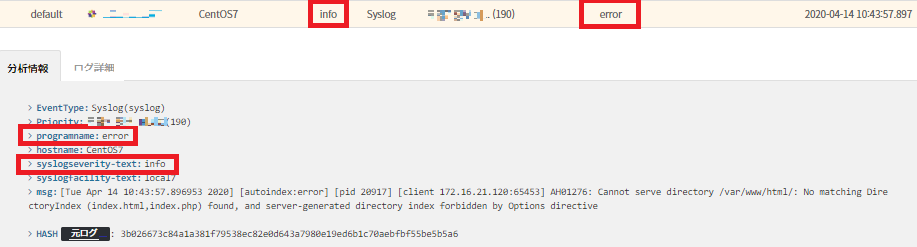
* ログ例 : 全体ログ > ホスト
* [x] 上記の内容を活用してフィルターを登録すると、探知ログを確認することができます。
> [https://docs.plura.io/ja/fn/comm/filter/syslog](https://docs.plura.io/ja/function/common/filter/syslog)
### 参考サイト
>