> For the complete documentation index, see [llms.txt](https://docs.plura.io/ko/llms.txt). Markdown versions of documentation pages are available by appending `.md` to page URLs; this page is available as [Markdown](https://docs.plura.io/ko/faq/siem/logging/squid.md).
# Squid 로깅 설정
### 1. Squid에서 PLURA 로깅 연동 설정
* Forward 프록시로 Squid를 사용할 때, PLURA 로깅을 연동하는 방법입니다.
* httpd와 유사한 방식으로 설정할 수 있습니다.
```
logformat httpd %>a %[ui %[un [%tl] “%rm %ru HTTP/%rv” %>Hs %h” “%{User-Agent}>h” %Ss:%Sh
access_log /var/log/squid/access.log httpd
```
### 2. PLURA 로깅을 JSON 형식으로 저장하는 방법
* 다음과 같이 `squid.conf` 파일을 수정하여 JSON 형식으로 로깅 데이터를 저장할 수 있습니다.
```bash
vi /etc/squid/squid.conf
```
```
forwarded_for on
acl has-xff req_header X-Forwarded-For ^(([0-9]+\.[0-9]+\.[0-9]+\.[0-9]+)|(\[([0-9a-f]+)?:([0-9a-f:]+)?:([0-9a-f]+|0-9\.]+)?\]))
# add logging for PLURA
logformat combinedjson {“Remote-addr”: “%>a”, “X-forwarded-for”: “%{X-Forwarded-For}>h”, “Request-date”: “%tl”, “Method”: “%rm”, “Request”: “%rm %rp HTTP/%rv”, “Host”: “%>rd”, “Uri”: “%ru”, “Resp-Content-Type”: “%mt”, “Refere”: “%{Referer}>h”, “User-Agent”: “%{User-Agent}>h”, “Status”: “%>Hs”, “Resp-Content-Length”: “%
### 3. Squid를 PLURA 웹 호스트로 인식시키기
* 다음 명령어를 통해 Squid를 PLURA 시스템에 웹 호스트로 등록합니다.
```bash
echo “ModPlura-squid” > /etc/modplura
```
```bash
echo “0.0.1” >> /etc/modplura
```
```bash
touch /etc/.modplura
```
### 4. Squid Access 로그 파일에 권한 부여
* 로그 파일에 권한을 부여하여 로그가 정상적으로 기록될 수 있도록 설정합니다.
```bash
touch /var/log/plura/weblog.log
```
```bash
chmod -R 766 /var/log/plura/weblog.log
```
```bash
chcon -t squid_log_t /var/log/plura/weblog.log
```
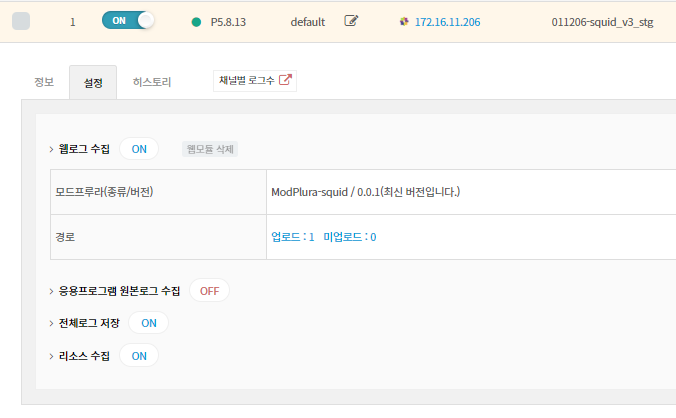
* [시스템 > 시스템 관리](https://docs.plura.io/ko/function/common/system/management)에서 리스트의 호스트를 확장하면 다음과 같이 확인됩니다.
### 참고 사이트
>
>
>
>
>
>
>
### 참고사이트 XFF
>